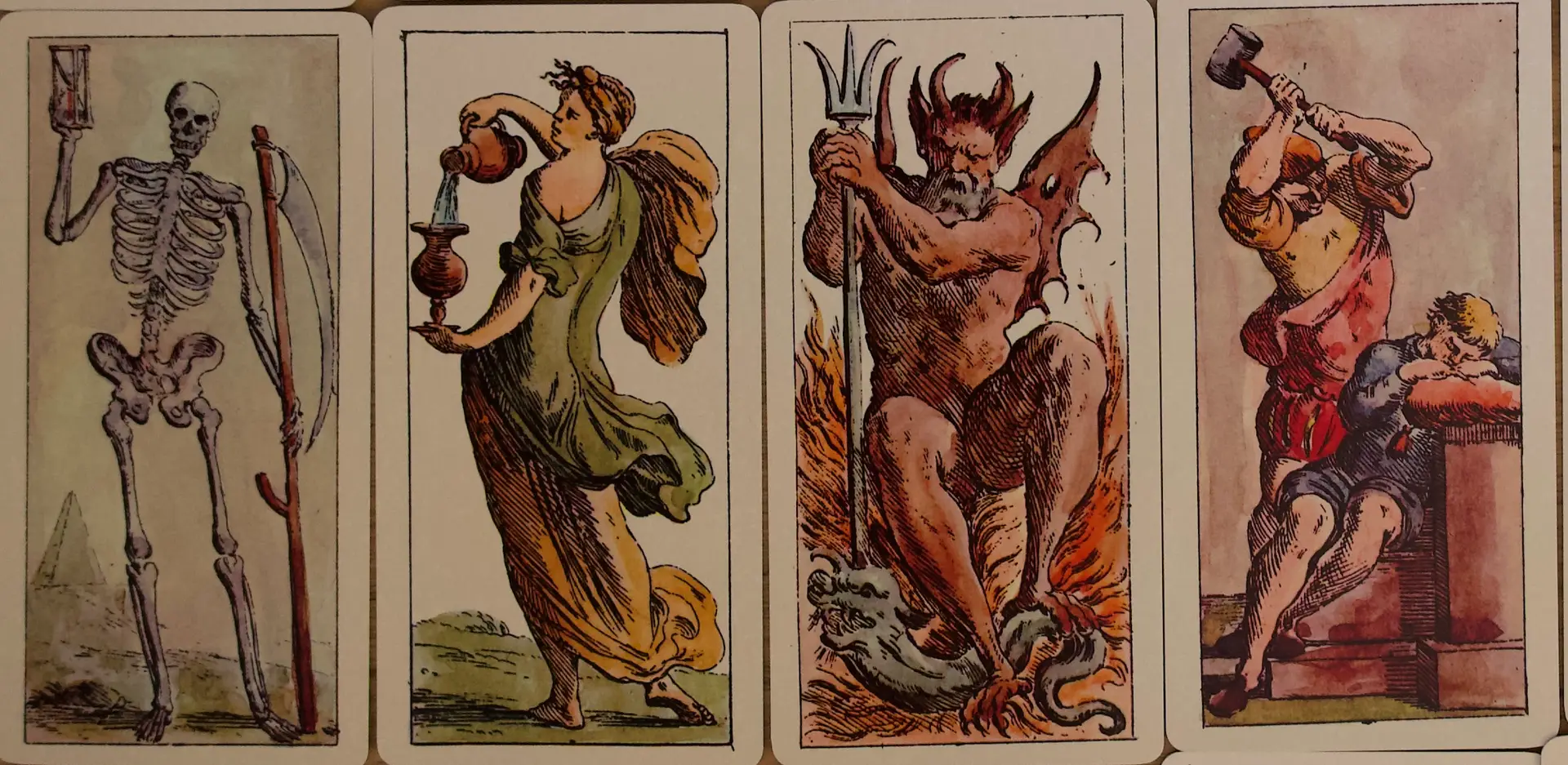
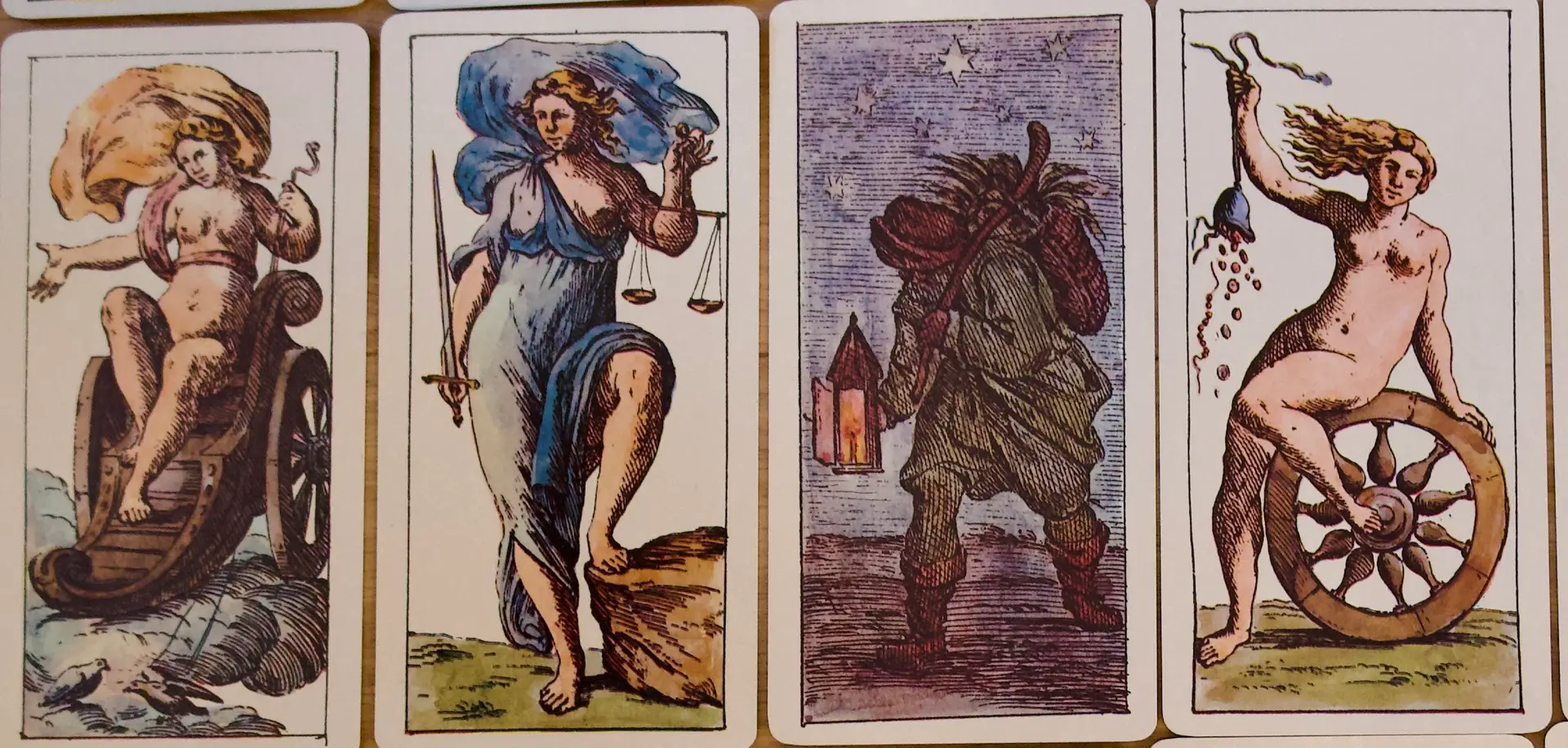
On the
Tarot Tradition
Historical and cultural context
The Inner Voice series engages with a rich, centuries-old European tradition of visual imagery. To understand the sculptures, it helps to look at how tarot evolved from a Renaissance card game into a profound language of the human psyche.
European Origins: From Game to Craftsmanship
Tarot emerged in Europe during the fifteenth century. The earliest documented decks appeared in northern Italy in the 1430s, when existing packs of playing cards were expanded with a set of specially illustrated trump cards and the Fool. Created within aristocratic and courtly circles, these early decks were originally used for games rather than divination.
Among the earliest surviving examples are the mid-fifteenth-century Visconti and Visconti-Sforza decks from Milan. These masterpieces represent an early form of image-making where fine painting, rich symbolism, and exquisite craftsmanship converged. Another rare historical reference is the so-called Tarot of Charles VI, of which seventeen princely cards survive today in the Bibliothèque Nationale de France.
As the tradition spread, it found one of its most influential visual articulations in the Tarot de Marseille in France. This style established a standardized visual language that played a crucial role in transmitting tarot imagery across the European continent.
The Esoteric and Psychological Shift
From the eighteenth century onward, tarot shifted from a courtly game into a framework for philosophical, symbolic, and esoteric inquiry. Thinkers like Antoine Court de Gébelin proposed connections to ancient wisdom traditions, while nineteenth-century occultists linked the cards to Kabbalah, astrology, alchemy, and numerology. While these layered interpretations were added over time rather than belonging to the cards’ historical origins, they profoundly shaped how tarot is understood in modern culture.
In the twentieth century, this evolution culminated in the iconic Rider–Waite deck, published in 1909. Illustrated by Pamela Colman Smith under the direction of Arthur Edward Waite, its visual language blended Christian symbolism, esoteric systems, and archetypal figures into a form that remains highly influential today.
The Major Arcana as a Universal Journey
A traditional tarot deck consists of seventy-eight cards, divided into the fifty-six cards of the Minor Arcana and the twenty-two cards of the Major Arcana—the word arcana meaning “mysteries” or “hidden meanings.”
The Major Arcana is widely understood as a symbolic sequence describing a universal journey through life: a movement through experience, transformation, crisis, and renewal. This journey begins with The Fool, a figure of pure openness stepping into the unknown, and unfolds through a series of encounters that represent different forces and stages of human experience.
This archetypal structure mirrors psychological frameworks, particularly those of Carl Jung, who recognized these recurring figures as expressions of patterns within the collective human psyche. Because figures like the mother, the ruler, the priestess, or the seeker represent universal human experiences, they can be recognized intuitively, without any prior knowledge of symbolic systems. It is a visual language that operates through intuitive recognition rather than formal education, making it accessible across diverse cultures and backgrounds.
A Contemporary Translation
Inner Voice roots itself in this deep European heritage. Christine’s work does not aim to reconstruct or illustrate historical tarot decks; instead, it translates their symbolic and archetypal structures into contemporary sculpture. In this series, the characters of the Major Arcana become physical, embodied presences—inviting viewers into a direct, spatial encounter with these ancient mirrors of the soul.